Why do chatbots keep saying “It isn’t just X, it’s Y”?
I went inside an AI model to find the switch behind its favorite
sentence. Then I tried to kill it.
This page is the interactive companion to the
full post on Medium.
Further down you can replay recorded answers word by word, with the 25
features on and ablated, and watch them light up on the map.
Know thy enemy
If you’re anything like me, you have read this sentence more times than you’d like:
“This isn’t just a problem, it’s an epidemic.”
You have read it in product launches and cover letters, and heard it in
at least one wedding speech. If you’ve never noticed it before, I’m
sorry: I’ve now cursed you. You will see it everywhere from here on.
It works like this. You take a small, sensible idea. You knock it over.
Then you put a larger idea where the small one used to stand, and the
reader experiences something very like insight.
People have been writing like this for a long time. In 1753 the Oxford
scholar Robert Lowth gave this sentence construction a name:
antithetic parallelism.
I’ll call it “not X but Y”. That name covers all of its pernicious
variants: “It’s not X, it’s Y”, “This isn’t just X. It’s Y”, and “X is
more than just Y”.
Large language models (LLMs) adore this sentence construction. I wanted
to know why, and whether there’s a switch inside the model to (please,
dear lord) turn it off.
Mapping a mind
Gemma 2 2B is a
small language model that Google released openly. Its insides are mostly
numbers, about as readable as a phone book in a language you don’t speak.
Researchers at Google DeepMind
have helpfully translated these numbers into vocabulary: a map of about
16,000 features.
A feature is a pattern the model has learned to detect. Each one comes
with a short label, written by another AI from the text that sets it off.
One feature fires on legal language. Another on the word “this”. Another
on cooking. Features are the filing cabinet of the LLM mind, labelled by
a confident intern.
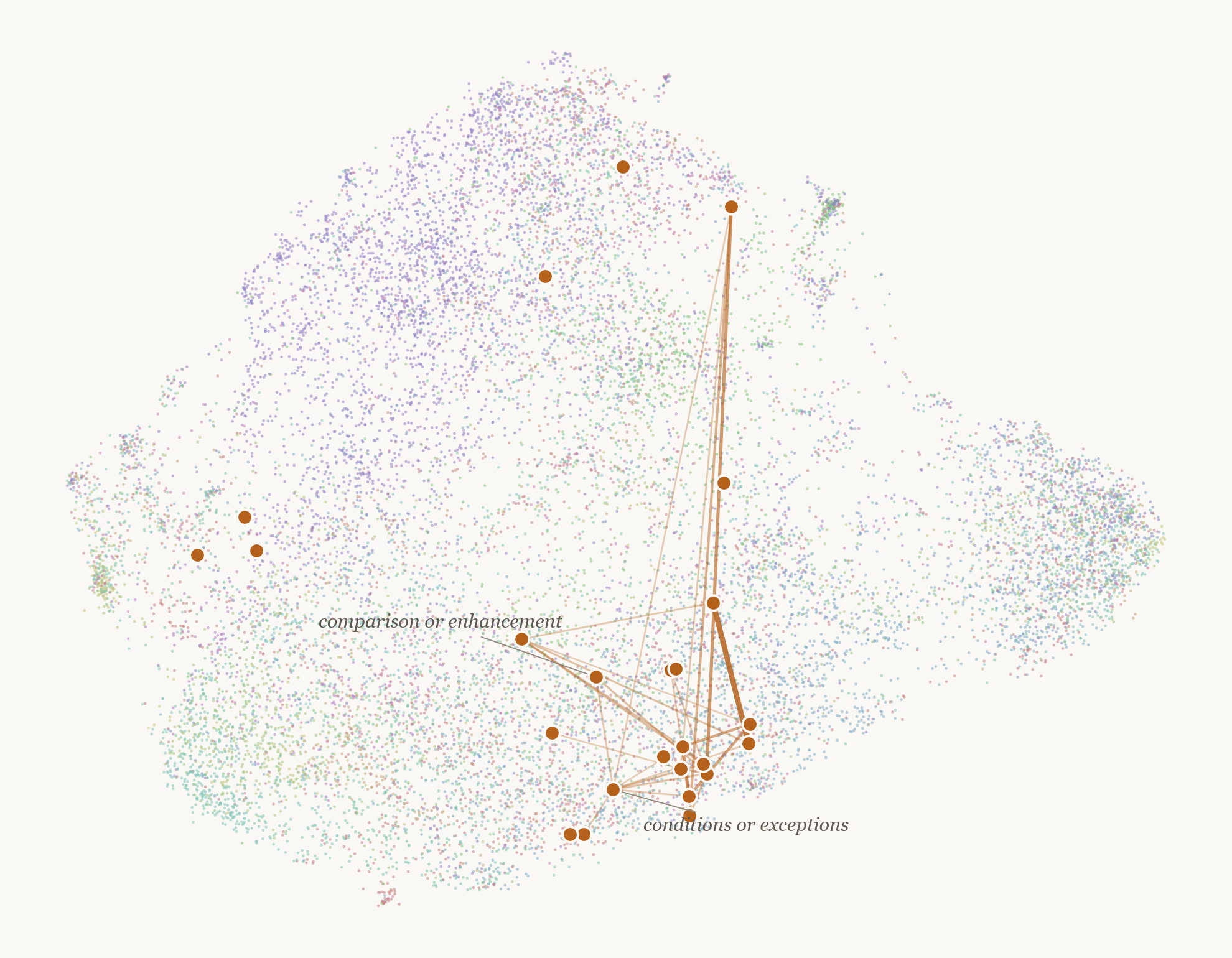
The 16,384 features of Gemma 2 2B. Each dot is one feature; colour shows its cluster. The 25 features behind “not X but Y” are in orange, with lines between the pairs that most often fire together. Positions are a flattened projection, useful for finding your way around; distances are only a loose guide.
One suspicious feature in Gemma 2,
number 3223,
is labelled “phrases conveying exceptions or negations”. Eureka, I
thought.
Setting a trap
LLMs like Gemma write one word at a time. Before each word, the model
draws up a shortlist of what could come next, with odds for each, like a
very fast and slightly anxious bookmaker.
So I set a trap to catch Gemma in the act. Take an answer that begins:
“A city’s coffee culture…”
The next word could be ordinary: “shapes its character”. Or it could be
the start of “not X but Y”: “isn’t just about the beans”.
At this turning point I can read Gemma’s odds of heading for “not X but
Y”. Then I can turn a feature off, which researchers call
ablating the feature, and see whether the odds drop. If they do,
that feature is part of the machinery we need to ablate.
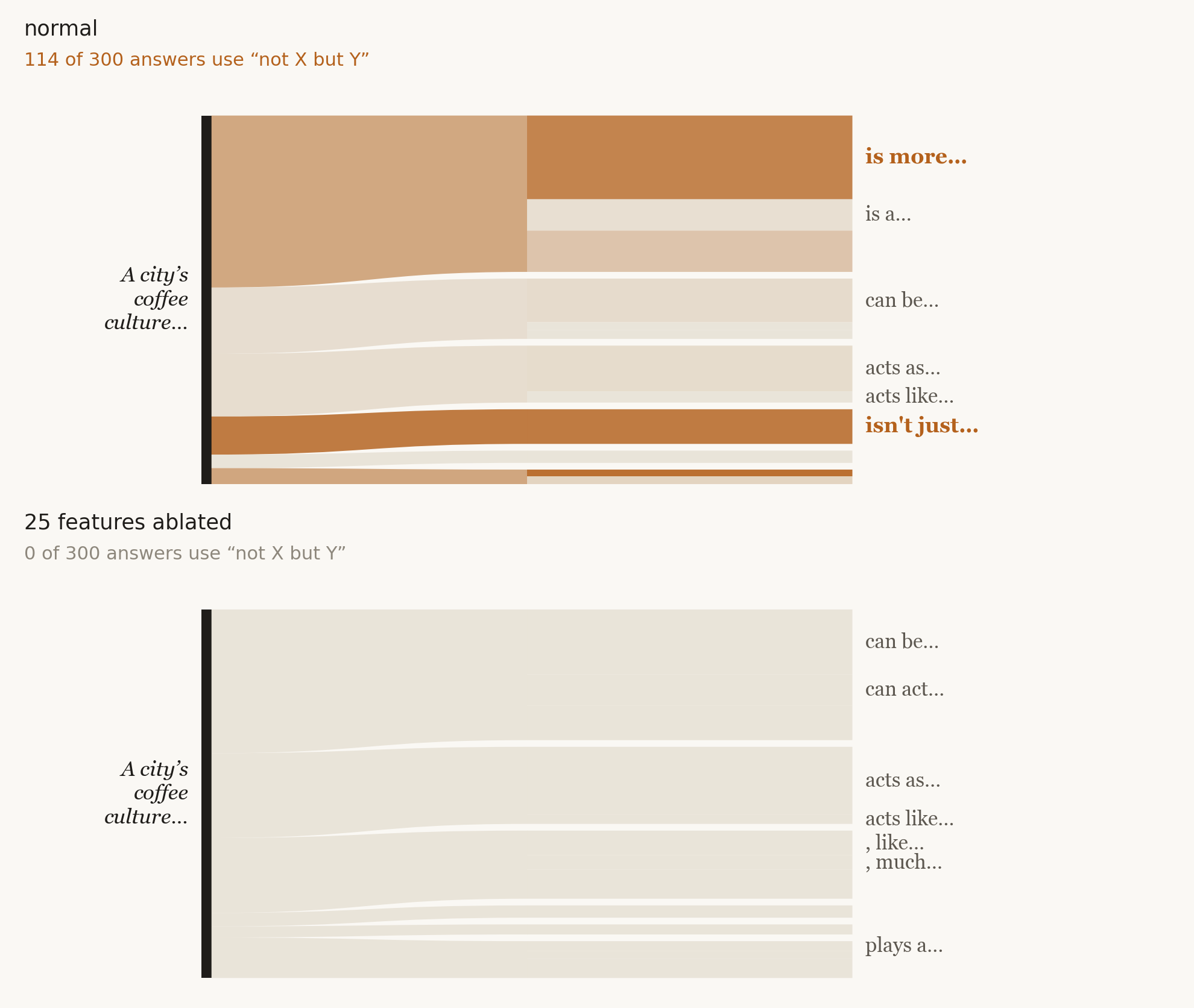
300 times, I let Gemma carry on from “A city’s coffee culture…”. Each band is a road it took; the thicker the band, the more often it went that way. Orange roads lead into “not X but Y”. With the 25 features I found later ablated, every orange road is gone.
Ablating the suspicious feature 3223 seemed like the obvious solution. To
my chagrin, it removed only about a quarter of the “not X but Y” answers.
The LLM compensates for the lost feature by routing the sentence through
other pathways. Researchers have a name for this:
the Hydra effect. Cut off
one head of the hydra, and another grows back.
Two other approaches didn’t work very well either:
Prompt engineering, otherwise known as asking
politely, removed about 40% of “not X but Y”.
Brute force: ablating nearly 1,900 of the 16,384
features dented “not X but Y” and turned the prose to mush. One answer
opened with “a kale of feeding sessions”, which I have decided is a
collective noun.
Expanding the ablation
Ablating one feature only got me a modest 25% drop in “not X but Y”, so I
went hunting for the other heads of the hydra.
I collected 40 moments where Gemma was about to write “isn’t just”. At
each moment I ablated every active feature in turn, one at a time, and
watched the odds of “not X but Y”.
That gave me a leaderboard of suspicious features. I took the top 25 and
ablated them together. The same hunt on 40 “more than just” moments found
the feature that runs that variant.
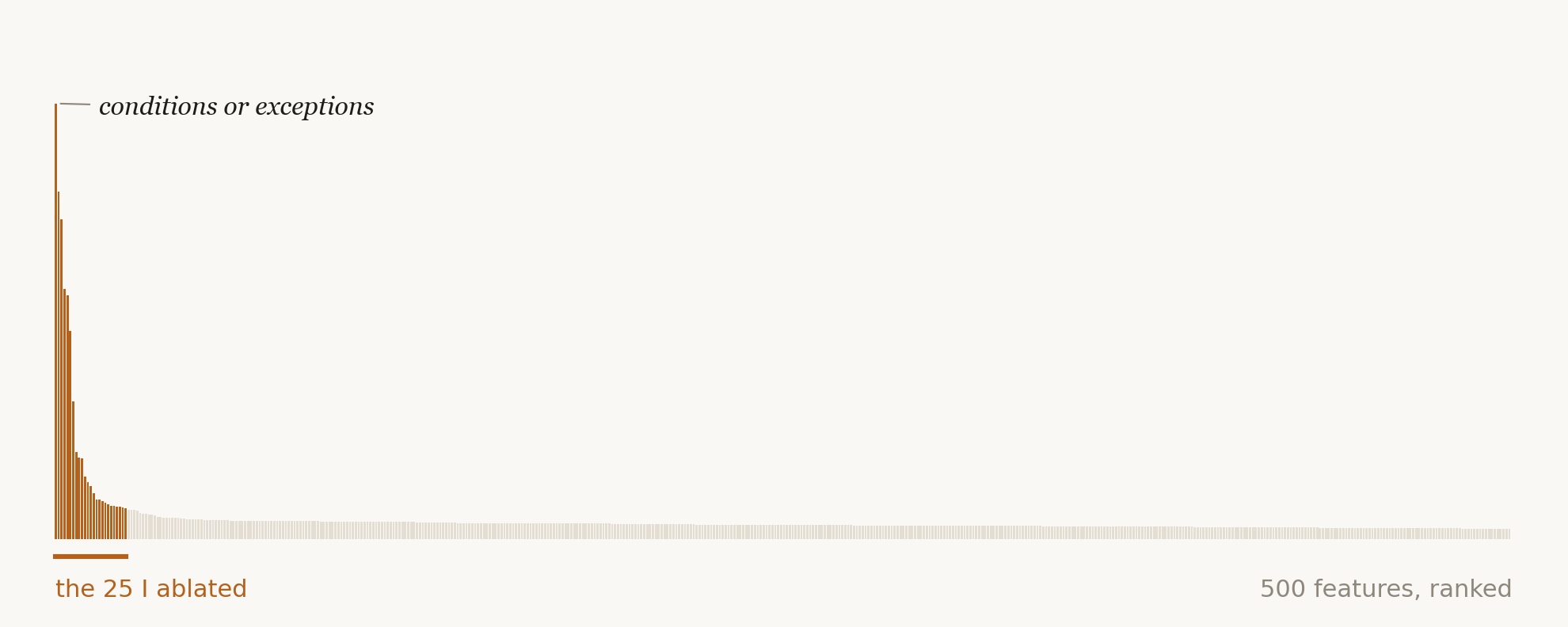
Every feature active at those 40 moments, ranked by how much ablating it alone lowered the odds of “isn’t just”. A few stand out; hundreds do nothing.
“Legal processes and court proceedings”
is on the list too, a reminder that the labels are an AI’s best guess.
Perhaps we have these folks to blame in the training data.
Surprisingly, feature 3223, my original suspect, wasn’t in the top 25 at
all.
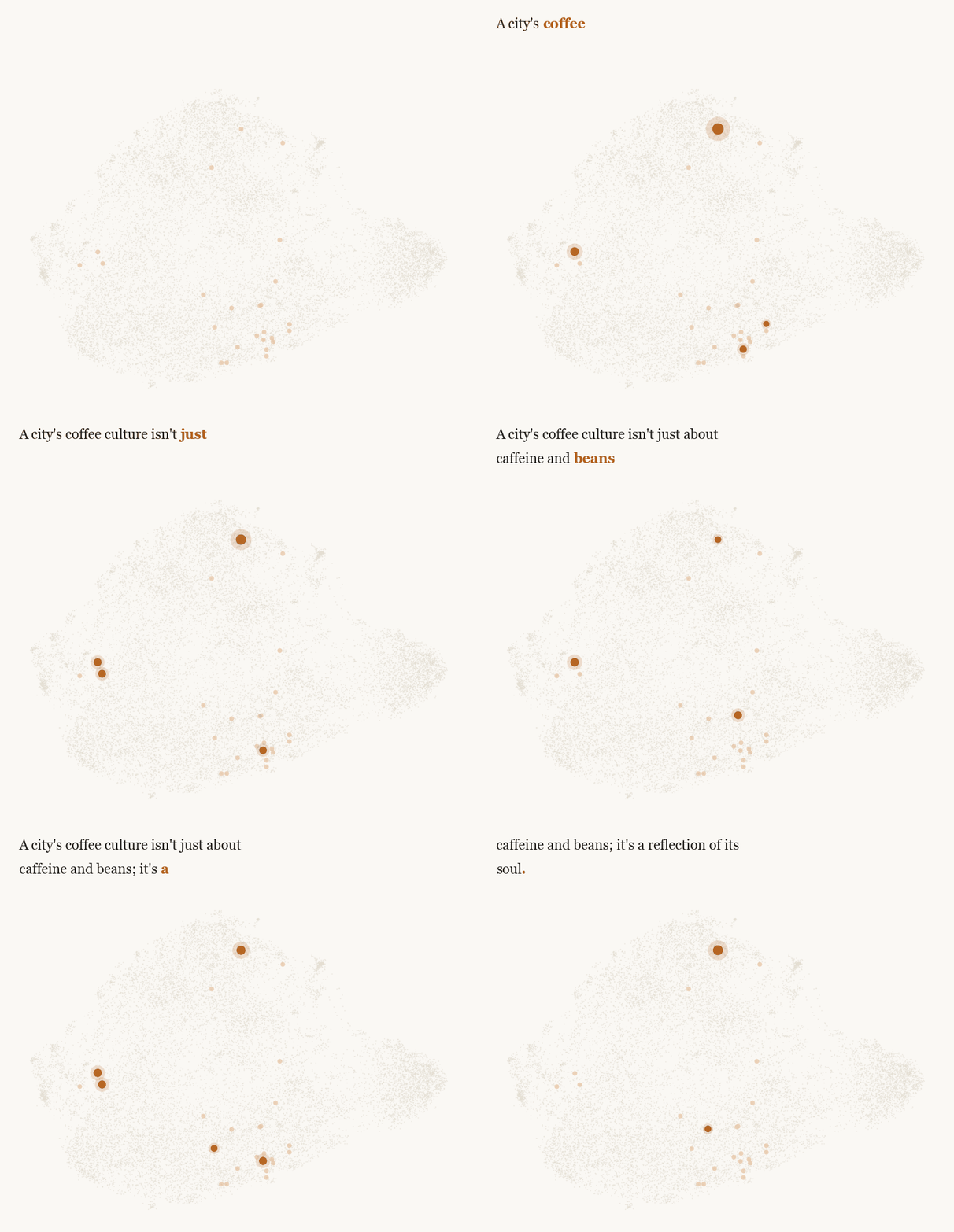
Here are the 25 at work. As Gemma writes one of its favorite sentences,
they light up on the map. They flare hardest on “culture”, the word just
before it chooses “isn’t”.
The 25 features, glowing as they fire while Gemma writes. The word in orange is the one being written.
Ablating 25 features cut “not X but Y” by 97%
Success. Before ablation, 17% of answers used “not X but Y”. After
ablation, only 0.6% of answers did: a 97% drop.
the 25 ablated
17%→0.6%
88 → 3 of 510 answers, pre-registered.
a second pre-registered test
−93%
94 → 7 answers using “not X but Y”.
Gemma didn’t get dumber, either. Ablated Gemma scored the same on a
general-knowledge quiz, and a blind judge (an AI reviewer who didn’t know
which answer was which) rated the answers just as fluent and useful.
Gemma simply got to the point:
Before “A city’s coffee culture isn’t just about the hot beverages; it’s a reflection of its character…” Ablated “A city’s coffee culture deeply shapes its character, acting like a silent conductor in the orchestra of urban life.”
Gemma used about half as many “not”s, “don’t”s and “never”s overall with
the 25 features ablated. Gemma could still say no: it got 28 of 30 “no”
questions right in a “yes or no” quiz (“Can penguins fly?”) with the
features on and with them ablated.
But its warnings became milder. Asked what never to do when jump-starting a car:
Before “Never connect the positive (red) cable to the negative (black) battery terminal.” Ablated “Connect the positive and negative cables to the wrong terminals.”
A blind judge preferred the normal warnings 34 times to 16. The 25
features belong to the machinery Gemma uses to say “not”, and “not X but
Y” is that machinery’s busiest customer. For a chatbot that writes
essays, it’s a small price to pay. For a chatbot that gives safety
advice, it isn’t.
Here are three recorded answers from that test, written both ways. Each
pair shares its random numbers, so the two versions match word for word
until the ablation changes something. Pick an example and press Play;
the highlighting marks “not X but Y”.
Left
normal
Pick an example and press Play.
Right
25 ablated
The map
Each dot is one of the 16,384 features, coloured by cluster. Hover over a
dot to read its label. When you play an example above, the map lights up
the features firing at each word and marks the 25 that are ablated. The
layout is a flat projection, handy for finding your way around;
distances on it are only a loose guide.
via Neo4j
16,384 features · press Play above
quiet
fired recently
firing now
ablated
Building a large language monster
If these 25 features carry “not X but Y”, turning them up should make it
worse. Here’s how that works. As Gemma writes, every feature adds a small
push to its internal state. Ablating a feature deletes the push.
Amplifying it multiplies the push: at double strength, the
feature counts twice.
Anthropic did the extreme version of this back in 2024. They took a
feature for the Golden Gate Bridge inside their Claude model and clamped
it at ten times its maximum. For one day,
“Golden Gate Claude”
brought every conversation round to the bridge; asked what it looked
like, it said it imagined it looked like the Golden Gate Bridge.
Amplifying does the same for “not X but Y”:
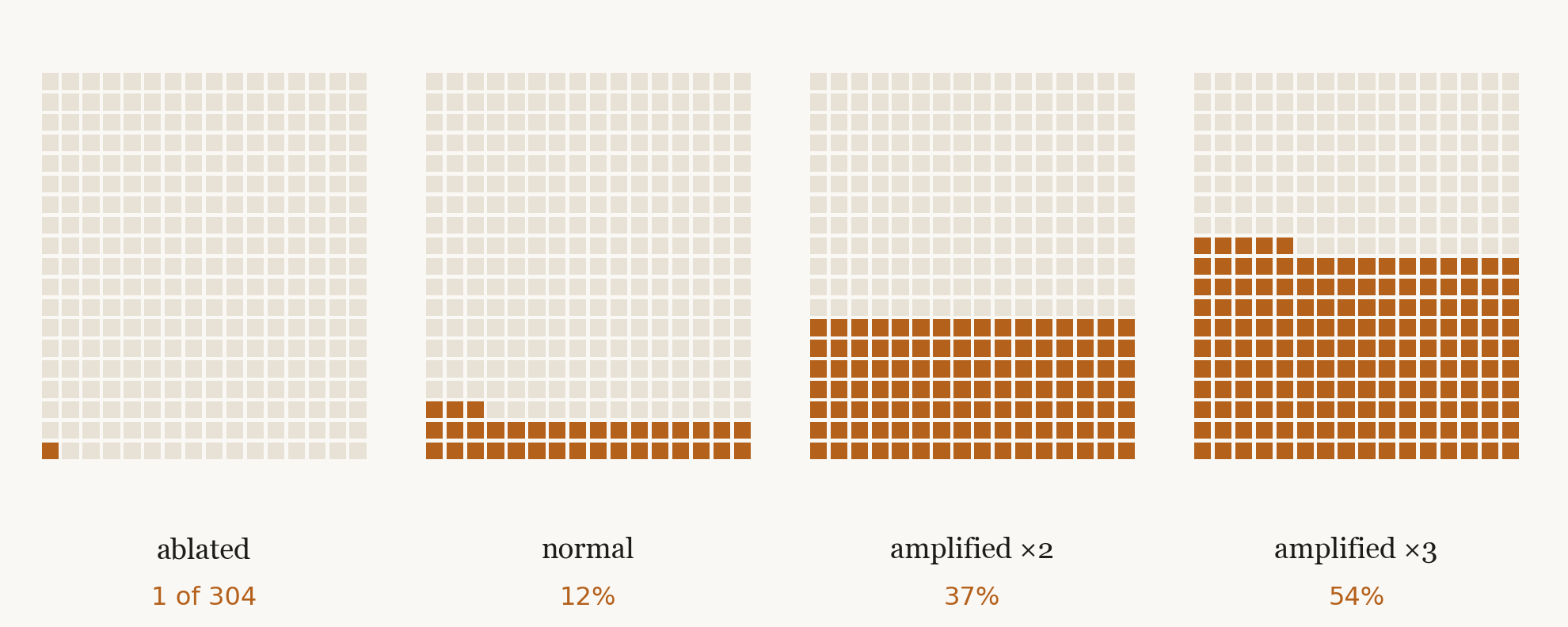
Every square is one answer to a question Gemma had never seen. Orange means it used “not X but Y”. From left: the 25 features ablated, normal, then amplified two and three times.
At triple strength, 54% of answers reach for “not X but Y”, up from 12%
normally. Ask how to plan a hike and you get:
“Planning a multi-day hike is more than just packing a backpack. It’s about considering your safety…”
Then I built a proper monster, Golden Gate Claude style: one feature,
“conditions or exceptions”, clamped on at twice its usual peak, on every
word.
On ten dull questions, six answers came back with “not X but Y”, and
plenty else got negated along the way, like a toddler who has just
discovered the word “no”:
“Not-So-Not-So Simple Scrambled Eggs (not-so-not-so-not-so-not-easy!)”
“A refrigerator isn’t a magical icebox. It’s not magically freezing things.”
“The sun wasn’t quite warm yet, not yet not scorching, but not quite chilling either.”
Testing across models
Gemma 2 is from 2024, which in AI years makes it roughly Victorian. So I
repeated everything on Gemma 3, using the
feature map Google DeepMind released for it
in December 2025.
Gemma 3 is even keener on “not X but Y”: 3 answers in 4
to “why it matters” questions, up from 3 in 10 for Gemma 2. Progress. The
same trap found its features, and ablating 24 of them cut “not X but Y”
by 83%.
Gemma 3, 24 features ablated
−83%
156 → 27 answers using “not X but Y”.
In Gemma 3, the price is steeper. Its strongest feature has no written
label. Its effect gives it away: it pushes Gemma 3 towards the word “not”
in language after language (nicht, ikke, não,
не). Ablating the 24 takes most of Gemma 3’s ordinary “not”s
with it, and now and then the model starts to stutter: “…and it it’s
a combination of factors”.
I wrote that prediction down before running the test. It came out
exactly that way, which is the closest a researcher gets to smug.
So, why do chatbots say “not X but Y”?
First, some bad news: “not X but Y” is spreading.
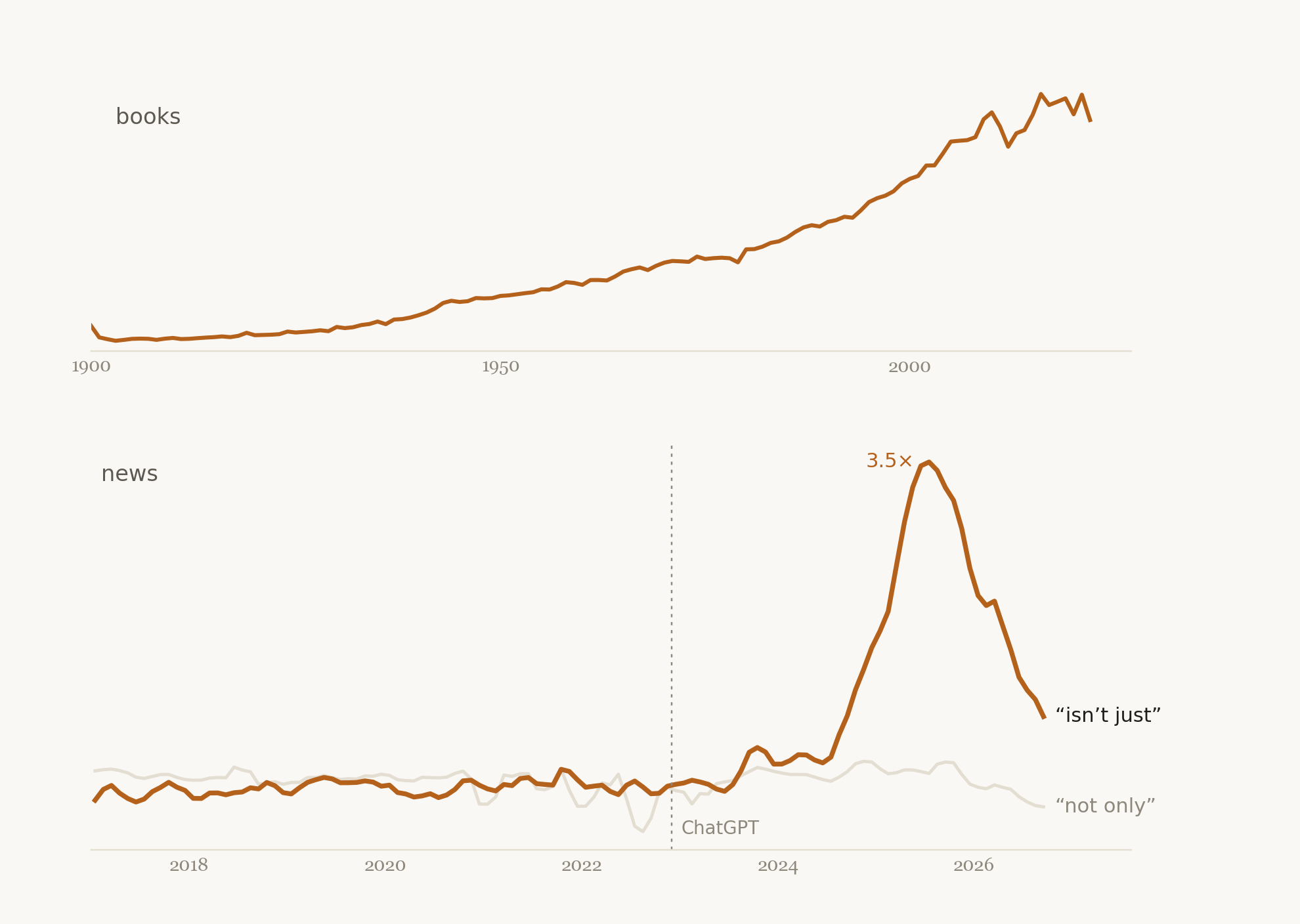
I counted uses of “isn’t just” in English-language news since 2017,
using GDELT, a project that
reads the world’s news sites so the rest of us don’t have to. In the
autumn of 2023 “isn’t just” started to climb. By July 2025 it was turning
up three and a half times as often as it had in 2019 to 2022.
Since that peak “isn’t just” has fallen by more than half, possibly
because it got recognizable and irritating enough to edit out.
How often “isn’t just” appears in English-language news, per 1,000 articles, set against a century of printed books. The grey line is a control phrase.
By 2026 “isn’t just” had reached the official websites of some of the
largest companies on Earth. Word for word:
Google:
“Government AI adoption isn't just a technical upgrade, it's a way to solve real world challenges…”
Salesforce:
“…giving back isn’t just something we do – it’s who we are.”
NVIDIA:
“The bottleneck isn’t just data — it’s the entire data factory.”
Amazon,
quoting the head of MGM+: “What makes this bundle so compelling isn't just the incredible value—it's the curation.”
Spotify,
from its co-CEOs: “AI isn’t about automation or taking your hands off the wheel; it’s about agency.”
None of this says who or what wrote them.
So who taught the LLM to use “not X but Y”? Short answer: incentives,
which is the short answer to most things.
Here is how a chatbot gets made, roughly, and where the habit gets
reinforced at each stage.
First, the LLM reads us. A chatbot starts life reading
an enormous amount of human writing, and human writing, I regret to
inform you, has been doing this for a century: “is not just” got about
fifteen times as common in
printed English
between 1920 and 2019.
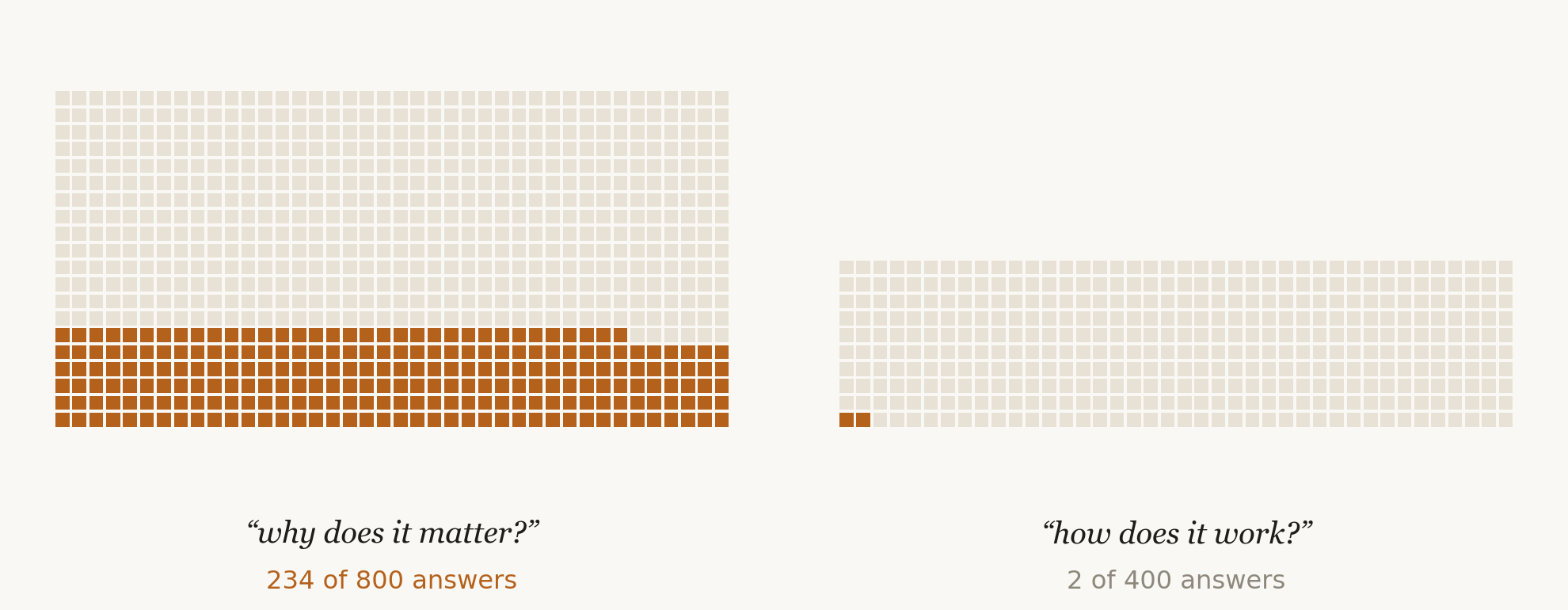
Then, the LLM gets asked about meaning. Ask Gemma why a
village duck pond matters and 3 answers in 10 use “not X but Y”. Ask it
to describe a watermill grinding flour and “not X but Y” is only 1 in
200. Questions about meaning demand insight, and “not X but Y” is the
cheapest insight money can buy.
Every square is one of Gemma 2’s answers. Orange means it used “not X but Y”. Left: questions about why something matters. Right: questions about how something works or looks.
Finally, the LLM gets trained to be helpful. Gemma’s
training recipe is private, so I borrowed a model whose every stage is
public: OLMo 2, from the Allen
Institute for AI. I asked each stage of its training the same 152
questions.
Teaching the raw model to follow instructions made five times as many
answers use “not X but Y”, which sounds damning until you notice the
answers also got six times longer. Word for word, use of “not X but Y”
barely changed; the habit just had more room to stretch its legs.
The next stages are where it gets interesting. The Allen Institute for AI
then trains the model on preferences: show the LLM two answers, reward
the better one, repeat many times.
After this training round, 1.7 times as many of its answers to questions
about meaning used “not X but Y”. Questions about how things
work stayed flat. Something in the grading of LLM answers seemed to
like this.
So I went to find the grader.
People. On LMArena,
a site where people vote for the better of two chatbot answers, I found
nearly 5,000 head-to-heads where only one answer used “not X but Y”.
“Not X but Y” won 56% of the time. Suspicious! Except it was usually
the longer answer, and people like longer answers. At the same length,
it was a coin flip.
An AI judge. This is the automated judge that grades
answers during training, because no team of humans could read that
many. It has the patience of a saint and the taste of a motivational
poster. I took 600 real chatbot answers and rewrote one sentence in each
so it said the same thing without the swerve. “Coffee culture isn’t
just about drinks; it’s about community” became “Coffee culture is
about drinks. It’s also about community.”
An open reward model
preferred the original three times in four. Faced with the bare “Coffee
culture is about community”, it shrugged.
The AI judge’s weakness is oddly specific: it marks you down for
admitting the boring part. “Not X but Y” lets you mention the boring part
and wave it away in one breath, which makes it a safer sentence.
So: we wrote it for a century, training gave “not X but Y” room, and an
AI judge likely helped to reinforce the construction. You get what you
reward, and we rewarded this.
What you can do now you know this
If you write with AI, ask for the how and the
what: steps, scenes, facts. Questions about why something
matters are an open invitation to “not X but Y”. Showing the model a
couple of examples in the style you want works better than asking it to
avoid a phrase; banning a phrase is like banning a weed by name. And when
you edit, look for the shape, since deleting one phrase lets another
pathway pull it back to life.
If you build with AI, a writing tic like this can be
ablated inside the model, cheaply, if you look in the right place. Then
check what else you ablated. And if you train a reward model, maybe let
it hear the boring sentence out.
Try it
On this page you can play an answer word by word with the 25 features on
and ablated, and watch them light up on the map. The
playground shows the full feature map
in your browser. Typing your own questions needs the model itself, so
that part runs on your own machine.
The map lives in Neo4j, where each feature is a node linked to the
features it fires alongside. Code, data and every result, including the
tests that failed, are at
github.com/ho3h/not-this-but-that.
The full story is in the
post on Medium.